Contemporary musicians increasingly merge classical and jazz elements. This column often features genre-defying music. Today, I highlight three new releases that showcase this creative freedom.
#313 Mika Stoltzman’s Latest Work Takes Straightforward Approach to Classical Music
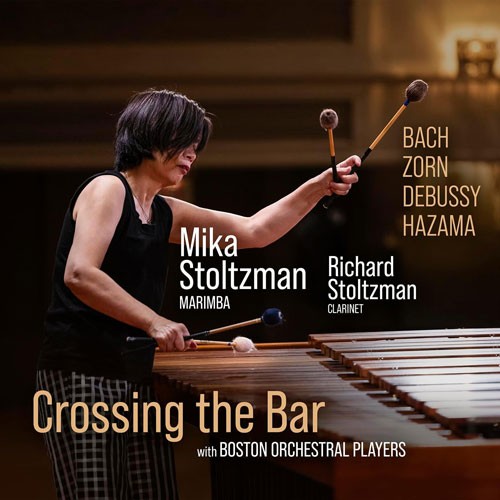
Crossing the Bar / Mika Stoltzman
(Tokyo M-Plus RAV-2807)
World-renowned marimba player Mika Stoltzman’s latest album, “Crossing the Bar,” is an ambitious work featuring her interpretations of classical compositions. The first track, titled <Partita No. 2 BWV 1004 ~ Chaconne in D minor,> is a variation that serves as the final movement of J.S. Bach’s Partita No. 2, BWV1004 for solo violin, composed in 1720. Although Mika Stoltzman has already recorded this piece, arranged for marimba solo, she performs it here in a new arrangement featuring The Boston Symphony Orchestra’s string ensemble and others. Unfolding over 18 minutes, the gentle tempo lets graceful lyricism blossom. The conversation between marimba and strings creates a rich, inviting atmosphere that warmly draws listeners in. Continuing with the album, the next track, <Breathturn ~ Part 1,> is a piece by John Zorn, with whom Mika has frequently collaborated, and features her husband, the renowned clarinetist Richard Stoltzman. A true treasure on the album is the world premiere of “Marimba Concerto No. 1,” a piece written with care by Grammy-nominated composer Miho Hazama specially for Mika Stoltzman. This piece also adds jazz bass and drums, delivering a musical expression unique to Hazama — fluid and versatile, yet taut with tension.
Mika Stolzmann released the jazz album “Memories of Tomorrow” late last year, and her near-simultaneous release of jazz and classical albums clearly demonstrates her ability to move freely between the two genres. In addition to its musical content, the classical album is also an interesting work from an audiophile perspective, thanks to its superb recording that realistically captures the marimba's sound, making the most of the wood’s texture.
#314 Popular Album Showcases Keith’s Improvised Score, Now Performed As Composition

THE KOLN CONCERT / Chinami Yamaguchi
(diskunion Terasima records TYR-1135)
In 1975, Keith Jarrett, a pioneer of solo piano, recorded “THE KOLN CONCERT” for ECM. Keith’s signature “solo piano approach,” in which he performs on stage without a set plan, improvising as his emotions guide him, has yielded numerous classic albums, but this concert, held in Cologne, Germany, stands as one of his absolute masterpieces in terms of musical quality. Owing to its remarkable richness and enduring popularity, the concert’s performance was transcribed and published in 1991, establishing it as an invaluable score for researchers. Nevertheless, only a select few performers have presented the score on stage or recorded it in a studio, regarding it as a significant “work” in its own right. Continuing this legacy, classical pianist Chinami Yamaguchi undertook the bold experiment of taking the score that Keith had improvised and performing it as a “composition” in its own right, just as one would a classical piece.
Chinami Yamaguchi graduated at the top of her class from the Music Performance Department at the Osaka University of Arts. Since her 2017 Kioi Hall recital, she has gained attention in classical circles and recently performed Rachmaninov with the Osaka Symphony Orchestra. A hallmark of classical music is playing the score faithfully while adding the performer’s own personality. What makes Yamaguchi’s approach truly unique is her interpretation and performance of a score originally created from jazz improvisation. Thus, it’s fascinating to see how the improvised solo Keith performed 50 years ago continues to influence and shape today’s music. The piano Yamaguchi plays is a Bösendorfer. This performance was recorded at King Sekiguchidai Studio in Tokyo, and the sound quality is excellent.
#315 Listening to Newly Remastered Version of ETJ’s Classical Repertoire
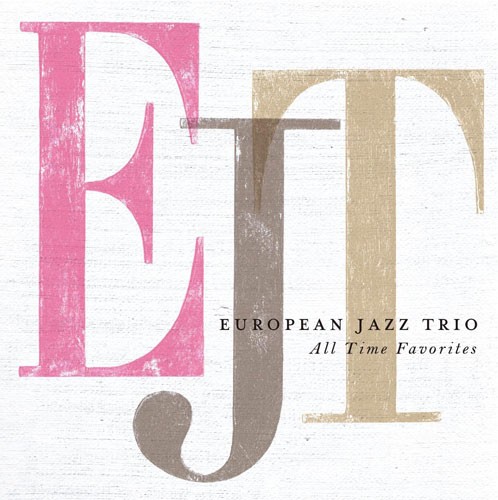
All Time Favorites / European Jazz Trio
(PONY CANYON PCCY-30253)
Named for its members, the European Jazz Trio (EJT) is a piano trio that plays jazz. Formed in 1988, the group has remained active, with more than 30 years passing since pianist Marc Van Roon joined. Despite their orthodox format, the trio’s repertoire spans many classical masterpieces, reflecting European sensibilities. As Van Roon says, “Since I joined the trio, I’ve had a strong desire to interpret classical pieces in my own way. ETJ is the ideal trio for bringing my vision to life.” Building on this passion, the group delights in drawing on famous classical melodies as source material and presenting them in stylish arrangements that offer a unique listening experience.
Released in late 2025, “All-Time Favorites” is ETJ’s best album, featuring half of the tracks reimagining the melodies of classic pieces. The first piece, <Adagio,> features the melody from the second movement of Beethoven's Piano Sonata, “Pathétique.” Two pieces by Bach, <Jesus, Joy of Man’s Desiring> and <Air on the G String,> and three pieces by Chopin, <Chanson de L’adieu,> <Mazurka No. 1,> and <Waltz in A Flat,> were chosen as source material. Although this is a best-of compilation featuring tracks from past albums, it has been newly remastered for this release, providing even better sound quality than the original recordings.
About the Author

Masamichi Okazaki
Surrounded by various kinds of music from his childhood, Masamichi Okazaki joined Waseda University Modern Jazz Club. He started contributing articles to music magazines when he was a student. He covers wide range of music not only trad, modern and contemporary jazz, but also from pops to classics. He writes liner notes for CDs and LPs, and is a regular contributor to “JAZZ JAPAN,” “STEREO,” and others. He joined a big band, “Shiny Stockings,” as a saxophone player. He is a director of The Music Pen Club Japan (MPCJ).